Architectural objects and their design as a subject for semiotic studies
Architectural objects and their design as a subject for semiotic studies
GEOFFREY BROADBENT
Portsmouth Polytechnic, School of Architecture, King Henry I Street, Portsmouth PO1 2DY, UK.
After an exposition of the basic notions of semiology this paper reviews designed objects (here architectural products) in terms of these notions.
Attempts have been made to discover by empirical studies what meanings people attach to built forms. The way in which forms are put together by the designer is treated as related to the syntax of language. Here, a number of theoretical studies are discussed. Reference is made to a limited application in practical design.
It is argued that the aspects of meaning and syntax cannot be completely separated. Because of this there is a case for examining the semantic dimension in more detail. Further, since some architects have found one or more of the semiotic approaches of value in design generation, there is ground for believing that semiotic approaches have application throughout the whole of designing.
Semiotic, in the sense used here, is concerned with the general theory of signs, of how one thing 'stands' for another. There have been several attempts to develop such theories, of which the two best known are those of Ferdinand de Saussure, a Swiss philosopher who lectured on the subject at the University of Geneva between 1902 and 1906, and Charles Sanders Pierce, an American surveyor whose voluminous Collected Papers contains many cryptic and ambiguous references on the subject. Both fundamentally were philosophers of language, interested above all in meaning but they both felt that principles extracted out of language, could be generalized for analysing the process of signification in other fields. It is worth quoting what they both say. As Saussure put it in the lectures which formed his Course in general linguistics
Language is a system of signs that express ideas, and is therefore comparable to writing, to the deaf-mute alphabet, to symbolic rites, to codes of good manners, to military signals, etc. It is simply the most important of these systems. A science that studies the life of signs in society is therefore conceivable: it would be part of a general psychology; we shall call it semiology (from the Greek semion 'sign'). Semiology would teach us what signs are made of and what laws govern their behaviour. Since this science does not yet exist, no one can say quite what it will be like, but it has a right to exist and it has a place staked out in advance.
Pierce on the other hand put it:
I hope to have shown that logic in its general acceptation is merely another word for semiotics, a quasi-necessary or formal doctrine of signs. In describing the doctrine as 'quasi-necessary' or formal, I have in mind the fact that we observe the nature of such signs as best we can, and, on the basis of fine observations, by a process which I do not hesitate to call abstraction, we are led to eminently necessary judgements concerning what must be the nature of the signs used by the scientific intellect.
Current interest in the subject really developed in the 1950s after Claude Levi-Strauss, the French Anthropologist had pointed out that certain phenomena in social anthropology could best be understood in terms of conceptual structures developed by Saussure in his Course — most particularly his distinctions between diachronic linguistics; which is concerned with changes in languages over time and synchronic linguistics which is concerned with the structure and inter-relationships between languages at a particular moment in time. The latter, in fact, became the foundation for that whole French-based exercise in cultural investigation known as Structuralism in which everything from mathematics, the biological sciences, psychology,
language, the social sciences, philosophy, history, myth literature, to travel guides and strip-tease were stretched over the same intellectual framework.
But somehow design never quite fitted into this structuralist ethos which seems in any case to be fading away. The extensive territory it occupied during the 1960s seems now to have been taken over in many cases by semiotic which has been developing not only from different aspects of Saussure's course, particularly from those concerned with the nature of 'sign' but, more particularly, from Pierce's more extensive analyses of different kinds of signs. The First Congress of the International Association for Semiotic Studies, held in Milan in 1974, attracted over 600 people, representing over 30 disciplines — wider in range than even the literature of structuralism.
The most comprehensive definition of what semiotic contains probably was attempted by Pierce’s pupil Charles Morris who saw it as concerned with three inter-related matters:
● Pragmatics which, he said, 'is that portion of semiotics which deals with the origins, uses and the effects of signs within the behaviour in which they occur'.
● Semantics which ‘deals with the signification of signs in all modes of signifying’, and
● Syntactics which ‘deals with the combinations of signs without regard to their specific significations or their relations to the behaviour in which they occur’.
We shall look at each of these in turn, drawing the various concepts from appropriate sources and considering their relevance for design.
PRAGMATICS
I should point out that as a designer, my particular orientation is towards architecture which is why, on the whole, my examples will be taken from that field. There is another reason, however, for concentrating on this area. Not surprisingly, the conventions set up for language analysis have not always been appropriate for analysing other sign systems. Language always operates in time within a single sensory dimension. We see the written word, we hear the spoken one. But the designed environment, including architecture, impinges on many of the senses simultaneously. I have tried to indicate this, within a context of natural and designed objects, in Table 1. Two things follow from this:
● That the sense of seeing is stimulated by a greater range of phenomena than any other sense.
● That ‘artefacts’ and ‘climate’ stimulate a wider range of sensory receptors than other phenomena.
It is not surprising therefore that buildings which, in addition to being artefacts, serve also (as we have seen) to control the physical climate, should offer a particularly wide range of sensory stimuli.
We may be able to develop a semiotic for each of these, setting up models according to our predilections but it will not be adequate unless it takes into account all the sensory modes by which buildings stimulate people. Certain clues are available from Zoosemiotics although like all forms of ethology, it affords the possibility of drawing too facile analogies between human and animal behaviours; but let us assume for the moment that we want, if possible, to develop it from existing semiotic methods. And let us further assume that functional models
Table 1. Architecture impinging on the senses
| The human senses which are affected | Distance senses | Skin senses | Chemical senses | Deep senses |
| Sensory stimuli which affect | Scenery | Sound | Touch | Pain |
| Other people's speech | ● | x | ● | ● |
| expression | x | ● | ● | ● |
| gesture | x | ● | x | ● |
| posture | x | ● | ● | ● |
| movement | x | ● | x | ● |
| skin | x | x | x | x |
| eyes | x | ● | ||
| Artefacts: | ||||
| graphic | x | ● | ||
| tools, weapons | x | ● | x | ● |
| furniture | x | x | x | x |
| machines | x | x | ● | x |
| painting, script | x | x | ● | ● |
| buildings | x | x | x | x |
| music | ● | x | ||
| Natural Phenomena: | ||||
| climate | x | x | ● | x |
| biological | x | x | ● | ● |
| topographical | x | ● | x | ● |
x direct perception
• indirect perception (e.g. Lip reading of speech)
of language and architecture will provide the most reasonable basis for cross-comparisons even though (as we have seen) most of those available seem hardly relevant to the purpose.
The next question, of course, is how the senses are affected by the various stimuli. No one, so far, has improved on Shannon's concept of an information channel, although I have elaborated it a little for our purposes (Figure 1).
The message source in this case is presumed to be someone’s brain whilst the destination, of course, is someone else’s. The source chooses particular signifiers within a context which consists of:
● certain predispositions, possibly innate, including a propensity to communicate
● the repertoire of signs built up on the basis of a lifetime's experience
● the source’s perception of the current situation.
These are all true whether the source is writing a sentence, designing a chair or playing a musical instrument, although in the case of natural phenomena the source, by definition, is not some human brain.
Koenig applied the information channel into architecture by analysing the whole system of architectural communication as follows:
● Sender: the architect or architectural team.
● Codes and lexiques: the functional, legal, structural and economic rules according to which a building is designed.
● Signal: the sum of drawings, models and written specifications of an architectural design.
● Channel: the construction-site.
● Physical signal: the material building resulting from the design signal.
● Noise: the environmental disturbance of perceiving, and the physical disintegration of the architectural sign complex.
● Receiver: the human being, his sense organs.
● Significant aspect of the message: architectural space, including its qualifying objects.
● Codes and lexiques of the receiver: functional, legal, structural and economic expectations.
● Semantic noise: the prejudice of the receiver.
● Receiver as a collective: the city as a system of communications.
● Meaning (significant) aspect of the message: the original function which the architectural object denotes and the second function which it connotes. (translation, Dexter )
This is an interesting, if somewhat too literal an interpretation, although Koenig's emphasis on semantic problems in the last three items has many implications, but we really are looking for something more fundamental.
When I send you messages, the transmitter consists of my body, or any part of it capable of generating signifiers. These include:
● the mechanisms which produce speech
● the hands which can make gestures, hold a pencil, pen brush, press keys, turn knobs, pull levers, brandish tools, weapons etc.
● the facial muscles, especially those around the mouth and eyes;
● the limb and body muscles responsible for expression, gesture, posture, movement and those which signify arousal;
● the skin which may flush, perspire, emit chemical signals; ● the eyes, and especially the pupils which according to emotional state may dilate, change colour, etc.
I have voluntary control over some of these, such as the mechanisms which produce speech and I shall describe their output as symbols. But I cannot control pupil dilation, flushing etc. — I shall call such phenomena signals. Natural phenomena too are signals in this sense. Symbols (or signals) emitted by these means will be transmitted along the communications channel and may stimulate certain of your sensory receptors.
Yet when the functions of language are considered in more detail some surprising parallels emerge between them and the functions of designed objects. Robinson collates Bales , Erwin and Firth (in Hymes ), Halliday and others, together with an analysis of the speech event itself by Jakobson. His 14—item taxonomy for the Functions of language is grouped under the headings of function, described technically and by an everyday name, its focus as a verbal act, its ‘primitive’ forms both in general and in particular and some basis for evaluating its success. Certain of these need not concern us here, but we can use the others as a basis for comparing the functions of language with the functions of the designed environment (Table 2).
Once we allow that language has these pragmatic functions, items 1 – 5, 7 – 9 of Robinson’s taxonomy, then the parallels become clear. At this level we don’t even have to translate linguistic concepts metaphorically into the designed environment; their application is obvious and direct.
There has, of course, been a considerable amount of empirical work in this pragmatic area by physiologists, psychologists, sociologists and architects using their methods
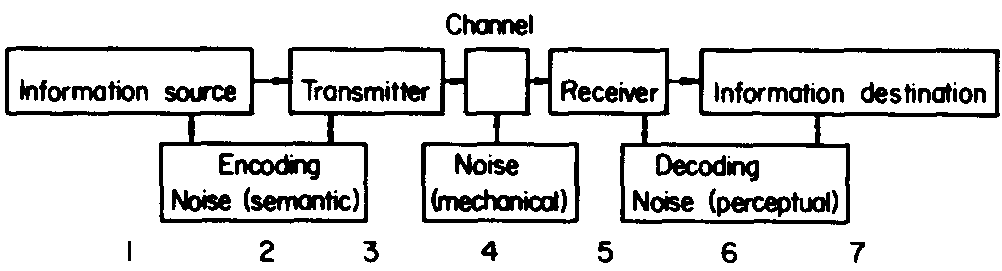
1 The information source (e.g. a human brain) wishes to pass a message to the information destination (e.g. another human brain) so as to modify the latter's behaviour.
2 This information consists of ideas, thoughts, concepts (signified) about people, objects or things (referents), which have to be codified into words, images, symbols (signifiers) selected from those available in the language. Sometimes no precise signifier exists, i.e. one which denotes the referent directly: the message has to be codified in terms of analogies, metaphors etc. selected by the information source for their connotations. This may introduce distortions (semantic noise) into the coding process.
3 The encoded message is then transmitted by some appropriate medium – speech, writing, drawing etc. according to the nature of the communications channel. The transmitter converts the message into a signal.
4 The channel may take any form which is capable of conveying information: radio, TV, a book, a letter, a drawing etc. Strictly speaking it is the medium used in conveying the signal from transmitter to receiver; a pair of wires, coaxial cable, band of radio frequencies, beam of light, marks on surface of paper etc. Whatever channel is used, the signal may be perturbed by mechanical noise — a term which betrays the origins of information theory in telecommunications, where it refers to the clicks, bumps and hisses of a telephone channel. But it can be applied to any disturbance in any channel; smudged lettering, tea-stains on a drawing etc.
5 The receiver performs a reverse function to the transmitter; it decodes the signal and reconstructs the original message from it.
6 If the original signifiers carried largely denotational meanings, communication will be accurate — provided that the signal was not perturbed too much by mechanical noise as it passed through the channel. But if it contains signifiers with connotational meanings — analogies, metaphors and so on, then it is likely that the decoding will result in meanings which are rather different from those the source intended. The decoder will draw on his own experience of connotational meanings and this will introduce perceptual noise.
7 The destination’s behaviour will change as a result of receiving the message — if only to the extent of rejecting it. But if the change is other than that desired by the message source, the latter will have failed to communicate.
Most of it has taken one of the following forms:
● Attempts to correlate the performance of specific buildings in spatial, environmental and other terms with the user's verbal response to those buildings. Pioneered by Wells and then Canter of the Pilkington Research Unit at Liverpool and the Building Performance Research Unit at Strathclyde, and discussed extensively by the latter in various publications.
● Attempts to establish user attitudes to possible built forms at urban, whole buildings or individual room scale by measuring verbal response to photographs, drawings, models and so on. Pioneered at Strathclyde under Canter’s direction by Lau, Wool and others.
A great deal of work in these areas has been published in various journals and conference proceedings, such as those from Dalandhui; Kingston, Lund, Sheffield and Surrey, not to mention the annual meetings of the (American) Environmental Design Research Association (EDRA). There is a vast literature in the subject by now, of which the most accessible summaries probably are those by Proshansky, Ittelson and Rivlin , Craik , Altman, Canter and Lee.
Such works cover the whole range of people’s physiological, psychological and social reactions to buildings; some of it naturally is concerned with what buildings mean to people — or, at least, with what they say they mean.
A range of techniques has been used in this research, such as Osgood's Semantic Differential, which enables one to plot, with some accuracy, the meanings people attach to concepts in a three-dimensional 'semantic space'. Hershberger tried to establish a basic set of scales for use in environmental research whilst Acking and Honikman devised such scales and put them to different uses. Acing projected slides of interiors to his subjects and asked them to mark each room against his concept scales. He then analysed these scales and measured feelings of comfort and security, estimations of social status, physical appearance, degree of originality and so on. Honikman also asked his subjects to look at pictures of rooms and to rate them against scales: bad/good, dirty/clean, dark/light and so on.
One problem with Semantic Differential, as many see it, is that the scales in use are set up by the experimenter. This raises the obvious problems of any social survey; that the scales themselves may suggest things to people which otherwise they might never have thought of. At the same time, they may ask people to think of things (including buildings) in ways which they find quite impossible. It was to answer such objections that George Kelley developed his Repertory Grid technique (1963) – originally for the investigation of what people thought about other people. He asked each subject to write onto cards the names of certain very familiar people: father, mother, sister, brother, favourite teacher, most hated teacher and so on. Then he worked systematically through the cards – grouping them into threes and asking his subject to name any quality shared by two of the people which the third one did not share. They thought of ‘constructs’ such as friendly, helpful, intelligent and so on. Having thus listed the ‘constructs’ by which his subject thought about people, Kelly then asked further questions by which the subject ‘ranked’ the constructs in order of importance for him – is it more important to be ‘friendly’ than ‘intelligent’ and so on. Honikman and others have adapted this technique to establish the constructs against which people ‘construe’ the built environment or, in this case, photographs of rooms.
One subject construed the photographed living rooms against a range of constructs such as inoppressive/oppressive, spacious/crowded, informal/formal, fireplace/no fireplace, books/no books and so on.
There is a fundamental problem, however, in applying the results of such research. Suppose we could establish, for a particular population, that a particular room type, house form, or whatever actually was overwhelmingly more popular than another, should we then build only that type? Of course not, if we did that it would become so boring that people no longer preferred it. Yet Semantic Differential and Repertory Grid techniques may be useful for quite different purposes, in establishing the degree to which architect and client, student and teacher, or even architect and psychologist, agree or disagree on fundamental issues concerning architecture. Chris Abel has done a certain amount of work in this area already with architectural students and teachers, attempting to relate students' architectural constructs to the designs they actually produce and the tutor's constructs to the ways in which they criticise those designs.
SYNTAX
Morris’s syntactic dimension of course is concerned with the structures of sign-systems; with the ways in which their various parts relate physically to each other. Saussure actually has a very neat way of describing relationship between the semantic (he calls them ‘associative’) and syntactic (the adjective is ‘syntagmatic’) dimensions:
From the associative and syntagmatic point of view a linguistic unit is like a fixed part of a building, e.g. a column. On the one hand the column has a certain relation to the architrave that it supports; the arrangement of the two units in space suggests the syntagmatic relation. On the other hand, if the column is Doric, it suggests a menial comparison of this style with others (Ionic, Corinthian, etc.) although none of these elements is present in space: the relation is associative.
Obviously the column/architrave relationship is a structural one and words are related in sentences by equivalent structural rules. Saussure himself has a lot to say about that; at worst the analysis of sentences to reveal their underlying structure becomes the kind of parsing into nouns, verbs, adverbs and so on which bored us all to tears in language lessons at school.
Some linguists, such as Pelc have developed the study of syntax into the most tortuous kind of exercise in symbolic logic but the subject as a whole received a tremendous boost in the middle 1950s from Naom Chomsky who looked beyond this 'surface structure' of sentences to the 'deep structures' from which he saw they were generated.
Chomsky first sprang to the world’s consciousness with the Syntactic Structures of 1957, revising his initial thesis, to a considerable extent, in the Aspects … of 1965. He suggests that each of us possesses a basic understanding, which may be inborn, of certain fundamental relationships between ourselves and the world outside ourselves which, in Aspects particularly, he describes as deep structures. He makes no attempt to define these clearly, suggesting merely that they are ‘structures generated by the base component’. Base components, in his sense, consist of the words and the rules by which sentences can be generated we shall consider some examples shortly.
A sentence such as: 'The boy sees the girl' operates at several levels. It indicates that the boy is a sentient being with eyes; that he can perceive the world around him, and that at this moment he can see a girl, perhaps the only girl in his field of vision.
The deep structure, then, consists of a fundamental relationship between the boy and the girl which, in Chomsky's terms, I have expressed by means of a surface structure, consisting, in this case, of four words; a pattern of sounds or letters. According to Chomsky, deep structures are converted into surface structures by transformational rules; we understand these instinctively and they give us the competence to generate sentences which are grammatically correct. These transformational rules are based on the ways in which sentences are constructed into phrases; Chomsky would write them for the above sentence as follows:
● Sentence NP + VP (Noun Phrase + Verb Phrase)
● NP T + N (The + Noun)
● VP Verb + NP
• T the
• N Boy, girl, etc.
● Verb sees, etc.
The relationship between deep structure and surface structures therefore can be represented as in Figure 2. The same deep structure naturally can generate a wide range of sentences. Take a simple example as given in Figure 3. Our original sentence expressed a fundamental relationship between 'the boy' and 'the girl'; each of these sentences also expressed a fundamental relationship between some person – He, She, I and You and the world within which we all exist. Charles Fillmore's Case grammar is an attempt to describe a set of concepts and to identify the types of judgement at this fundamental level of which human beings are capable. But for our purposes, it will be sufficient to quote Onions who believed that only five basic sentences are necessary. Every sentence we generate may be represented by one of these, or by some variation on it:
He waits
He is a Frenchman
He eats ortolans
He gives me some
He pleases me.
Onions may be right, but if he is, the problem still arises as to how we operate transformations on them of the kind Chomsky describes.
Chomsky’s aim, although not clearly stated, was to write algorithms for the generation of sentences; fixed sets of instructions which automatically would lead to
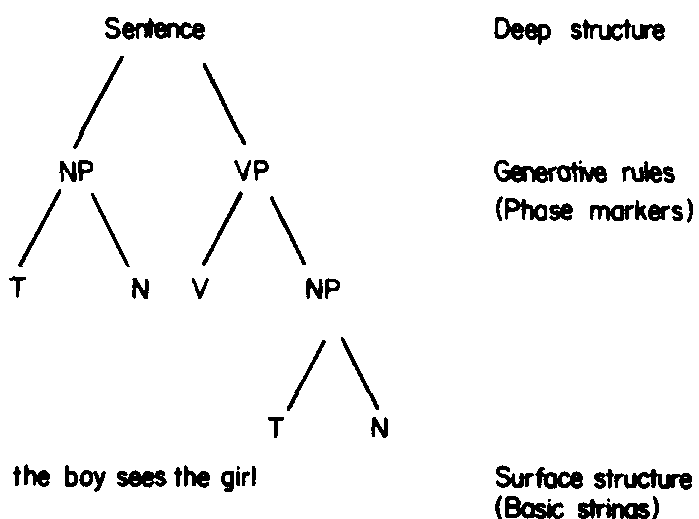
Figure 2. Relationship between deep structure and surface structures.
‘correct’ results. Chomsky’s algorithm is precisely of this kind and its operation, in generating our initial sentence is as follows:
Rule applied
| Sentence | 1 |
| NP + VP | 2 |
| T + N + VP | 3 |
| the + N + Verb + NP | 4 |
| the + boy + Verb + NP | 5 |
| the + boy + sees + NP | 6 |
| the + boy + sees + T + N | 2 |
| the + boy + sees + the + N | 4 |
| the + boy + sees + the + girl | 5 |
Having written algorithms for the generation of such kernel sentences, Chomsky suggests the possibility of writing further algorithms for transforming them into:
The passive: the negative: the interrogative: the affirming: the predictive: and so on.
These algorithms form his transformational rules.
At most, Chomsky’s algorithms generate or transform individual sentences; there is no suggestion as far as I know, that they be used to write books or even paragraphs. And similarly, algorithms have been written for the design of architecture, or rather for parts of architecture designing with the help of a computer: these include the structural frame, heating, lighting, and ventilation services, and even the drawing of perspectives.
Over half of the algorithms written in this field have been concerned with pedestrian, vehicular or services circulation, with pipework and drainage layouts and with space allocation problems; in other words, with the planning of buildings.
I recorded some of this work, and the basic approaches to it, in Design in architecture whilst March and Steadman, Hawkes and Mitchell and others have suggested how this whole approach can be generalized. The latter suggest that all built forms whether existing or under design, can be described in terms of geometrical elements, that these elements will have certain geometric and topological attributes, that there will also be geometrical and topological relations between them. This will be true whatever the level of detail with which one is concerned and also the levels of generality whether one is concerned, that is, with describing a single building or with some kind of basic form within which many variations can be developed.
They then go on to suggest that five main ways of representing built forms have been found to be the most useful. These are:
● Using regular grids or lattices.
● Using grids or lattices with variable dimensions.
● Using points in three-dimensional space.
● Using points in space located by some system of coordinates (point-vector representations).
● Using dual graphs; in which the spaces within one such system become the points with another.
● Using Smith diagrams in which, say, the walls of a plan are represented by points in an electrical network whilst the rooms are represented by the links between them.
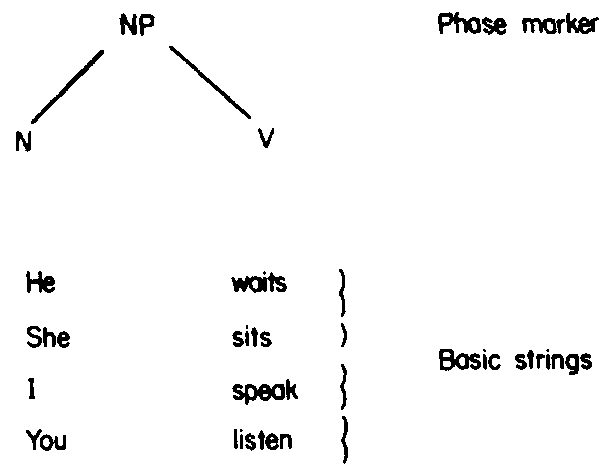
Figure 3. Deep structure can generate a wide range of sentences.
I mention these not to complicate the issue further but merely to indicate that if one wants to play syntactic games, then there are some very sophisticated techniques available. Yet sophisticated as they are, they still do not extend the two basic ways available to us for manipulating space which are:
● Taking small units and clustering them together according to whatever system of rules we choose for our clustering syntax.
● Taking a large volume of space and dividing it up, progressively, again according to whatever system of syntactic rules we choose to adopt.
One of the neatest sets of clustering rules probably is that devised by Hillier and Leaman who take a 'space' as that which is bounded by 'walls'. These can be solid or permeable – that is, open to the next space. Their syntactic rules are concerned with the number of adjacent spaces to which a particular space can be connected – 1, 2, 3 or 4 – with which a particular space may share a common bounding wall – 1, 2, 3, or 4 – the maximum which is possible topologically. Even with rules of this simplicity, they are able to generate a vast range of possible building clusters – detached, semi-detached, terrace and so on, and to match them with the 'reality' of settlement patterns through history. By adding further rules, such as one which states that, whereas each space may be bounded by four others, each also must be accessible from the exterior of the complex, they generate another whole range of possibilities, many of which also are matched by examples from history.
Mitchell, Steadman and Liggett have explored the other possibility; taking a 'given' space and dividing it up into every possible permutation of 2, 3, 4, 5 or 6 individual spaces.
Obviously it is one thing to pursue such spatial manipulations at this level of abstraction, quite another to apply them into design. Yet in one case, at least, some similar manipulations have been applied into architectural design, by the Taller di Arquitectura of Barcelona. Anna Bofill and Jose Augustin Goytisolo have demonstrated the efficacy of such studies at two levels of operation; at the level of individual activity-space and at the level of complete urban form. They have pursued a continuous development of the minimal space required for one, two, three or more people to wash, cook, eat, sleep and so on, thus building up a vocabulary – somewhat on the lines of Christopher Alexander's 'patterns' of activity-volumes which can then be clustered together in various combinations to generate an infinitely developing range of apartment forms, from the most conventional to the most extraordinary. In one case, for instance, the developed form is a single-person apartment in which, among other things, the bath is open to the living room. This was derived in the first place as merely another possibility within a wide-ranging permutation but once it had been derived, it was then built as a prototype apartment form at Walden 7, a recent development in Barcelona where it proved surprisingly popular.
Such applications of syntactic manipulation, arising out of architecture itself of course are perfectly reasonable, but others have developed syntaxes of a much more abstract kind – developed in fact out of Chomsky. One should record that Chafe and others have found Chomsky's analysis sadly lacking. Even though the whole enterprise is supposed to be an exercise in syntax, nothing could be more fraught with meaning than his deep structures, if he actually said what they were, but that is not quite the point. The point is that in addition to those who have looked at architectural syntax in a generalized way, some architects have tried quite deliberately, not only to analyse architecture from a Chomskian point of view, but even to use his concept of deep structures, developed by generative and transformational rules into surface structures, as the basis of an actual design process.
The most prominent of these is Peter Eisenman. Eisenman has demonstrated the possibilities in a series of house designs (he is now up to house 10!) together with descriptions of his processes by himself, Gandelsonas, Tafuri and others. As Gandelsonas puts it:
One of the most interesting and original aspects in the work of Eisenman is the discovery of the possibility of modifications within architecture which are the result of a shift from the semantic to the syntactic. By 'paralysing' the semantic dimension, the syntactic dimension is seen in a new light …
In a typical case (House 12) Eisenman starts with a cube of space. This can be subdivided, of course, by means of a grid (Eisenman chooses one which divides it into 3 x 3 squares) a total of 9 compartments in all on each floor. The grid can be defined by a system of columns, a system of walls, or both. Eisenman examines both possibilities and then various ways in which they can be interrelated.
In one case, for instance, he divides his cube diagonally and runs parallel cross walls along his grid line to meet this diagonal. He then looks at the 'negative' spaces set up by these walls and gradually elaborates a complex system of spatial division, the various parts of which, eventually, are dedicated to the various activities of living.
There is no question, in Eisenman's case, of trying to generate the plan-form out of 'need' – he pursues instead a line of abstract perfection into which the physical realities of living eventually will have to be fitted. In House 6 this pursuit of an abstract 'structure' goes so far that the master bedroom, for instance, contains a long slot in the floor as part of its abstract pure form, with the (single) beds arranged on either side. Presumably the inhabitants are expected to lead such disciplined lives that they never expect to risk life (and limb) by trying, impulsively, to cross the gap.
Eisenman, of course, is by no means the first architect to have developed a syntax of this kind. Sir Edwin Lutyens, no less, worked with an Armature of planes which his son describes as follows:
A building is made up of solids and voids … which … are geometrically related … To state this relationship it is first of all necessary to visualise space … as divided along three planes, mutually at right angles, into a number of cubical cells. One series of planes is vertical … The two other series of planes are vertical, at right angles to one another … This visualisation of a space divided in all directions becomes an
'armature of planes', or foundation of three-dimensional relationships. It should be thought of not as a grid or frame of three intersecting sets of lines … but as almost invisible 'lines of cleavage', the whole being like a glass cube made up of smaller glass cubes.
It seems to me, however, that all these attempts to withdraw from the semantic dimension, to design an architecture of pure syntax, are doomed to failure. For the fact is, as Jencks so clearly points out, people will read meanings in building whatever the architect intended. They cannot help it; indeed the only way, as we know from the psychology of perception, the only way any of us can encompass something new is to compare it with our past experience to see where it 'fits' in our personal scheme of things compared with the things we know already.
No one with the scantiest knowledge of Le Corbusier, with the white-walled villas which he, and others, built in the 1920s can possibly help recalling these when faced with one of Eisenman's white-walled constructions. The one 'reminds' us of the other, there is nothing we, or Eisenman, can do about it. He cannot succeed in his aim of designing an architecture of pure syntax.
But let us suppose for a moment that he could. Then what? Again there are examples from linguistics of what happens when syntactically 'correct' sentences are put together with no regard at all for the semantic dimension. Chomsky cites two of the most revealing, one of which is: Curious green ideas sleep furiously.
In each case, adjectives, noun, verb and adverb are put together with perfect propriety yet the result, literally, is nonsense. How can it be possible that architecture put together by precisely analogous processes can make more sense than that?
SEMANTICS
If the semantic dimension cannot be avoided, then of course we should look at it more closely. It happens
Table 2. Functions of language (from Robinson )
| Function | Destination of verbal act | Basis of evaluation | Designed equivalent |
| 1. Avoidance of other problems | All those taking part | Has uncomfortable silence or other problem been avoided? | Filling a gap in the environment perhaps with a routine solution so as to avoid the responsibility of creative design. |
| 2. Conformity to norms | Subscribing to rules | Have the rules been followed. Was the corpus of speech recognisable as belonging to a set form? | Routine solution to a problem. |
| 3. Aesthetic delight | Enrichment of receivers experience | Is the result beautiful, moving etc.? | “Good” design. |
| 4. Regulation of encounter | Interaction between participants | Was a contrater make? Did conversation flow; was it suitably terminated? | Planning routes, barriers, etc., so that people can find their way around easily. |
| 5. Performatives such as promising betting, etc. | Physical or other action with which verbal act is associated | Has the act itself been performed? | Signs, notices etc. which confirm those facts about an environment which could have been deduced from the environment itself, e.g. that a building is a church. |
| 6. Regulation of own actions by comment, encouragement, etc. | Self (message source) | Is performance improved by verbalising? Is one’s mind changed or induced? | Planning of building in such a way that user’s behaviour is controlled by implication, e.g. by planning of circulation etc., or directly as in the case of a prison. |
| 7. Regulation of others by comment, encouragement, etc. | Receiver’s | Have others obeyed, been dissuaded, made to laugh, etc? | |
| 8. Expression of feeling | Self | Do you feel better for swearing, expressing affection, etc.? | |
| 9. Expressing of personal characteristics personality, social identity. | Destination | Has the desired impression been conveyed? | Direct expression of what the environment is for, etc. |
| 10. Marking of roles within relationship | Emitter and receiver | Have roles been defined according to accepted formulae? | |
| 11. Discrimination organisation, storage and transmission of information concerning the non-linguistic world in the spheres of logic, science, ethics, meta-physics, etc. | Correspondence of verbal act to nonverbal world | Is the argument true, valid? within the agreed universe of discourse? | |
| 12. Instruction | Receiver, who is being taught | Has he learned? | |
| 13. Inquiry | Acquisition of knowledge by emitter | Has a gap in his knowledge been filled? | |
| 14. Meta-language functions | Linguists | Have we learned something new about language? | Have we learned something new about the environment. |
however that one of the basic concepts was anticipated by none other than Vitruvius himself who wrote:
… in all matters, but particularly in architecture, there are those two points: the thing signified and that which gives it significance. That which is signified is the subject of which we may be speaking; and that which gives it significance is a demonstration of scientific principles.
Saussure’s concept of a sign is exactly like this. He thinks of it as a two-part entity, consisting of a signifier and a signified, formally united by social contract. The signifier in this case consists of some material representation – the speech-sounds, marks on paper and so on from which, maybe, a word is formed whilst the signified consists of the concept to which that word refers.
Initially, the relationship between word and concept was quite arbitrary. There was no particular reason why the English should call a certain animal 'bull', the French call it 'boeuf' whilst the German call it 'ochs'. A particular animal which happened to be grazing on the Franco-German border might well be called by all three names, simultaneously. But because the relationship between signifier and signified initially was arbitrary it must be respected by everyone. No one can change it unilaterally; a social contract now exists between all English speaking people that we shall use the word 'bull' whenever we want to refer to that particular animal; if one of us used some other word, or coined a new word for the purpose, no one could understand him; he would have broken the social contract. Let us note in passing that with a few exceptions, no such social contract exists to the meaning of architecture, this is a fundamental difference between architecture and language.
Others since Saussure have developed his concept of sign in various ways. Ogden and Richards for instance felt his two-part entity to be by no means adequate; they took his signifier (they called it symbol) and his signified (which they called thought or reference) and added a third element the referent which is the actual object, person or event to which one is referring, hence their semiological triangle in Figure 4.
This has gained a certain currency in linguistic circles but Hjelmslev felt that it also was inadequate. He postulated the sign as a four-part structure which takes the following form (I have plotted equivalents in the Saussurean and the Ogden/Richard's schemes):
Hjelmslev:
Plane of content:
Plane of expression:
There may be advantages in splitting the concept which links signifier and referent in this way because it allows for a process of encoding between one's immediate thought about the object and the way one chooses to refer to it by means of words or other signifiers.
It should be pointed out that certain theorists including Eco are by no means happy with this extension of Saussure's sign to include the referent. They point out, rightly, that there is no necessary relationship between a signifier, a signified and a referent. A particular sign vehicle (signifier) may signify a fictitious object (such as a unicorn) or merely a set of abstract thoughts (signifiers) for which no object exists. Eco concludes from this that the object of a sign-system is its 'content', rather than some particular
referent, and that this 'content' is a kind of 'cultural unit' rather than an actual object. He gives several examples of content to which we may well subscribe even though the evidence for physical objects associated with them at best is tenuous. These include Napoleon's death (for which we have to rely on the testimony of historians) Alpha Centauri (astronomers), transubstantiation in the Christian liturgy (theologians).
So far, so good, but then he gives a final example: 'Take the term dog. The referent will certainly not be the dog x standing by me while I am pronouncing the word'. For anyone who holds to the doctrine of reference the referent, in such a case, will be all existing dogs (and also all past and future dogs). But 'all existing dogs' is not an object which can be perceived with the senses. It is a set, a class, a logical entity.
But one of my colleagues actually calls his dog 'Dog' – for which it must certainly be the referent. Eco's problem can be solved quite simply by taking his referent as a 'thing'. Provided one uses, say, the Oxford dictionary definition of 'thing': What is or may be an object of perception, knowledge, or thought (my italics).
Of course there is more to it than that, but even the most extreme of metaphysical philosophers now admit that a real, physical world does exist and whatever else sign systems may or may not do, they aren’t much good if they don’t refer to it.
Ogden and Richards are quite specific. The referent for them is 'a thing'. It is 'not an active person' nor is it the package of ideas about 'things' in general which Eco suggests it should be. In terms of the way the brain works, it hardly matters whether the 'thing' is a 'real' object in the physical world or something we dreamed about. We shall subject it to processes of thinking, in just the same way, however our ideas of it actually arose in the brain so let us agree with Ogden and Richards that the referent is a thing, but whilst realizing that a thing can be real or imaginary.
As for Eco’s insistence that rather than being dog x, the referent should be ‘all existing dogs’ – this merely confuses two perfectly ordinary terms; coterms in linguistics; connotation and denotation. Eco does this quite wilfully. He says: ‘The difference between denotation and connotation is not (as many authors maintain) the difference between “univocal” and “vague” signification … What constitutes connotation as such is the connotative code which establishes it …’ Those ‘many authors’ whom Eco dismisses probably would accept Pei’s much simpler definitions: denotation The meaning which a form has for all who use it (the intrinsic meaning of water). connotation The spatial shades of meaning (based on emotional or other factors) that a form has for its individual user (the evil connotation of profits for labour leaders, as against its favourable connotations for management …)
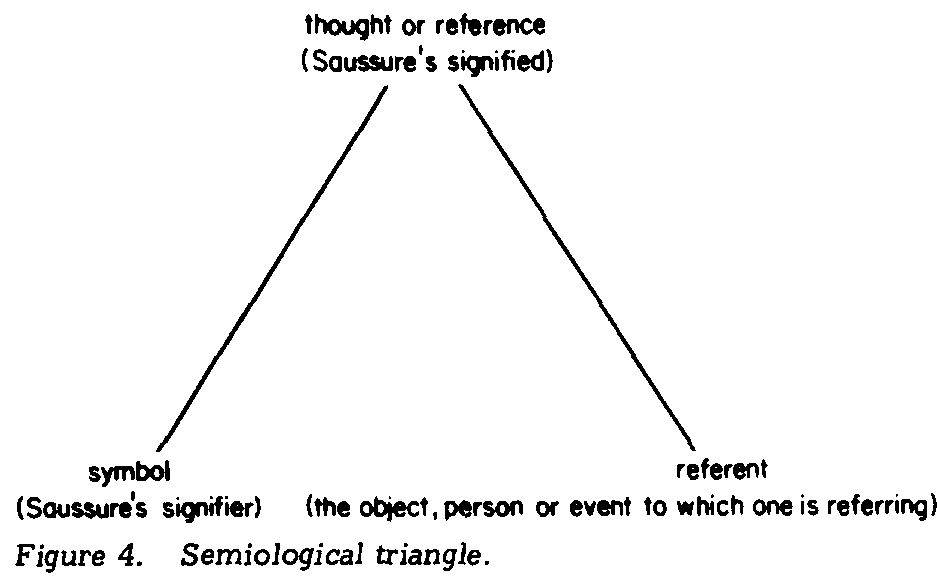
Figure 4. Semiological triangle.
DESIGN STUDIES
So whilst one need not necessarily dismiss Eco's Theory as does his Times Literary Supplement reviewer (1977) as 'a more or less gratuitous expression of an Italian esprit de systeme', it is much too interesting and stimulating for that, one cannot accept his dismissal of such patently useful concepts, nor his attempt to complexify what can be fairly straightforward.
Peirce’s semiotic is much more complex than Saussure’s semiology. At one time, Peirce identified 59,049 (310) different classes of sign which he later considerably reduced in number. There are scattered references to them in various of his collected papers² but they are difficult to quarry out. The papers themselves are often confused, ambiguous and self-contradictory; in addition to these, Peirce presents us with two other difficulties. First he was an inveterate ‘trichotomizer’ grouping everything taxonomically into sets of threes and secondly, he constantly flouted Saussure’s social contract, coining a new word or term for every concept which occurred to him. He wrote, for instance of firstness, secondness and thirdness; abstractives, concretives and collectives, of Phemes, Semes and Delemes; of potsigns, Actisigns and Famisigns, of qualisigns, sinisigns and legisigns. Of all his trichotomies, however, that which classifies signs into Icons, Indices and Symbols has proved to be the most fruitful. He defines them as follows:
An icon is a sign which refers to the Object that it denotes by virtue of certain characters of its own and which it possesses just the same, whether any such object actually exists or not.
A symbol is,
a sign which refers to the object that it denotes by virtue of a law, usually any associations of general ideas, which operates to cause that symbol to be interpreted as referring to that object
An index is a sign or representation,
which refers to its object not so much because of any similarity of, or analogy with it, nor because it is associated with general characters which that object happens to possess, and because it is in dynamical (including spatial) connection, both with the individual object on the one hand and with the senses or memory of the person for whom it acts as a sign.
Peirce’s icon, therefore, is an object which exists in its own right but which has certain elements in common with some other object and can therefore be used to represent that object. Maps, photographs and algebraic signs are icons in this sense, so are architect’s drawings. Unfortunately, though, Peirce’s definitions of icons are so ambiguous that a generation of semiotics is still concerned with trying to unravel what he actually meant by an iconic sign: Eco, Volli, Maldonado, Broadbent and others have contributed to this particular debate.
Peirce’s index is rather more straightforward; it is a sign which indicates some particular object or circumstance, in terms of a physical relationship. A pointing finger indicates which way to go, the pole star indicates North, a weather vane indicates which direction the wind is blowing from, and so on.
Most large buildings contain indices of this kind (in the form of notices and it could be argued that a building which fits exactly around a set of functions, such as a nuclear power station, is an 'index' of those functions. Peirce's symbol is even more straightforward: it is a sign which 'carries' some general meaning, thus a badge symbolizes the fact that someone belongs to an organization, a railway ticket symbolizes the fact that they have paid to travel. Ordinary words, in Peirce's terms are symbols in this sense. A church obviously symbolizes Christianity — Peirce's symbol has the specific quality that whatever relationship exists between the symbol itself and the entity which it, symbolizes, has to be learned, both by the user of symbols and those to whom its meaning is important. In this sense it closely resembles Saussure's sign a signifier and a signified with a learned relationship between them.
Buildings again can be symbols in Peirce’s sense. The gothic cathedral obviously is a symbol of the Christian faith; most of us in the Western cultures have learned the essential relationship between a building of that form and the religion which it symbolizes; we even share a social contract as to conventional church form. As for buildings as indices; one can think of many art galleries, museums, exhibition pavilions and even houses, such as Le Corbusier’s Maison la Roche 1923 which are planned about a set route.
Such buildings indicate to us which way we should go in moving around them so certainly they are indices. The 'functional' building also was intended to be an index, indicating by its form the functions which it houses.
Occasionally, it was successful, as in the case of certain power stations but most so-called ‘functional’ buildings are merely symbols of modernity. As for buildings as icons, any drawing, model or photograph of a building is an icon in Peirce’s sense, but the building itself also may be an icon; if it ‘reminds’ us of something else. I have described elsewhere certain buildings which were designed by visual analogy – with forms from nature, as in the case of Le Corbusier’s crab-shell roof at Ronchamp or the hands in prayer which suggested the roof-form of Wright’s Chapel at Madison, Wisconsin (1950); with modern painting as in the case of de Stijl architecture and so on (1920s). Such buildings obviously can be iconic signs of the forms from which they were derived, one of the clearest, obviously is the poultry stand on Long Island, to which Robert Venturi has drawn attention, (1973) shaped like a duck.
But also I showed that there is another kind of architectural icon — that is the kind of likeness between buildings which depends on some underlying structure, rather than on simple, observable, visual likeness. The clearest example of this, probably, is that suggested by March and Steadman who took three Frank Lloyd Wright plans (the Life house, the Ralph Jester house and the Vigo Sundt house) and showed that despite the obvious differences in the appearances of their plans (the first is based on rectangular geometry, the second on circular and the third on triangular) there was nevertheless a pattern of relationships between living rooms and terraces, terraces and pools, bedrooms and bathrooms and so on which underlay them all. In this sense, each was an icon for the other.
It should be clear therefore that in thinking of architectural design, the whole range of semiotic studies: pragmatic, syntactic and semantic, is of very considerable relevance. Not only does it help us to understand how architecture ‘works’ as a series of sign systems but there are indications already that some architects have found some semiotic approaches of considerable value in the generation of their own designs. Insofar as certain aspects of methodology, in particular those which determine the ways in which design-forms are actually conceived, are of universal application throughout the whole of designing, I have no doubt that these semiotic ‘tools’ will be equally valid in other fields of designing. But their actual relevance can best be judged by others with greater expertise than mine in those particular fields.
REFERENCES
1 Saussure, F de Course in general linguistics Peter Owen, London (1959)
2 Pierce, CS Collected papers of Charles Sanders Pierce Hartshorne, C and Weiss, P (eds) Harvard UP, MA, USA (1974)
3 Levi-Strauss, C Structural anthropology Allen Lane, The Penguin Press, London (1963)
4 Paiget, J Structuralism Routledge and Kegan Paul, London (1968)
5 Lane, B M Architecture and politics in Germany 1918 – 45 Harvard UP, MA, USA (1968)
6 Barthes, R Mythologies Editions du Seuil, Paris (1957) translated by Lavers, A Cape, London (1972)
7 Barthes, R (1966) Elements of semiology (translated) Cape London (1966)
8 Morris, C 'Foundations of the theory of signs' Encyclopaedia of unified science, vol 2, Chicago UP, USA (1938)
9 Sebeok, T Perspectives in Zoosemiotics Mouton, The Hague (1972)
10 Shannon, C E and Weaver, W The mathematical theory of Communication Illinois UP, USA (1949)
11 Dexter, B. Componental analysis: A working paper in Semiotics of the Environment. Proc. 8th Environmental Design Research Assoc. Conf. (1977)
12 Robinson, WP Language and social behaviour Penguin, Harmondsworth, UK (1972)
13 Bales, R F Interaction process analysis Addison-Wesley, USA (1950)
14 Tripp, E 'An analysis of the interaction of language, topic and listener' in Gumperz, J and Hymes, D (eds) 'The ethnography, of communication' Am. Anthropol. vol 66 no 6 (1964)
15 Firth (1964) Towards ethnographics of communication in Gumperz, J and Hymes, D (eds) 'The ethnography of communication' Am. Anthropol. vol. 66 no 6 (1964)
16 Hymes, D 'Towards ethnographics of communication' in Gumperz, J and Hyme, D (eds) 'The ethnography o communication' Am. Anthropol. vol 6 no 6 (1964)
17 Halliday, M A K 'Relevant models in language' Educ. Rev. vol 22 (1969)
18 Jakobson, R 'Linguistics and poetics' in Sebeok, TA Style in language Wiley, USA (1960)
19 Manning, P (ed) Office design: a study of environment Pilkington Research Unit, University of Liverpool, UK (1965) Design flow process chart ULM Reporting Back Conference in 'Appraisals of building performance: their use in the
design process AJ (9 October 1968) pp 793–6 (1967B) ‘Multi-disciplinary research for architecture’ AJ, 146 No 20 (1967) pp 1239–43
The primary school: an environment for education Pilkington Research Unit, University of Liverpool, U.K (1967) 'St Georges School, Wallasey: evaluation of a solar heated building' AJ (25 June 1969) pp 1715–21
20 Canter, D (ed) Architectural psychology Proc. Conf. Dalamdhui, University of Strathclyde, RIBA, London (1970)
21 Proshansky, H M, Itelson, W H and Rivlin, L G Environmental psychology Holt Rinehart and Winston, London (1970)
22 Craik, ICA 'Environmental psychology' Annual review of psychology 24 (1973)
23 Altman, I (1975) The environment and social behaviour Wandsworth, USA (1975)
24 Canter, D & Lee, TH (eds) Psychology and the built environment Architectural Press, London (1974)
25 Hershberger, R G (1972) 'Towards a set of semantic scales to measuring the meaning of architectural environments' in Mitchell, M J (ed) Proc. 3rd Environmental Design Research Assoc. Conf. (1972)
26 Aking, C A 'Perception of the Human environment' in Honikman, B (ed) Proc. Architectural Psychology Conference Kingston Polytechnic, RIBA, London (1969)
27 Honikman, B 'An investigation of the relationship between, construing an environment and its physical town' in Mitchell, W J (ed) Proc. 3rd Environment Design Research Assoc. Conf. (1972)
28 Honikman, B 'Personal construct theory and environmental evaluation' in Preiser: environmental design. Proc. 4th Environmental Design Research Assoc. Conf. VA, USA (1973)
29 Abel, C 'The Perception of other persons architectural constructs' Paper to the First International Design Research Society Conference, Portsmouth, UK (1976)
30 Chomsky, N Syntactic Structures Mouton, The Hague (1957) 31 Chomsky, N Aspects of the theory of syntax MIT, MA, USA (1965)
32 Fillmore, CJ 'The case for case' in Bach, E and Harms, RT (eds) Universals in language Holt Rinehart, USA (1968)
33 Onions, CT An advanced English sytext, London (1904)
34 Broadbent, G Design in architecture Wiley, p 299 UK (1973) 35 Broadbent, G ibid.
36 March, L and Steadman, P The geometry of the environment RIBA, London (1971)
37 Hawkes, D and Mitchell, W Mathematical models for the description and evaluation of architectural form (1977)
38 Hillier, W and Leaman, A Space syntax University College, London (1976)
39 Chafe, W Meaning and the Structure of Language Chicago UP, USA (1970)
40 Eisenman, P Notes on conceptual architecture II: Dual Deep Structures. Reprinted as 'Notes sobre arquitectura conceptual: estructura profunda dual' in Llorens, T (ed) Arquitectura, historia y teoria de los signos, Colegio Oficial de Arquitectos, Barcelona, Spain (1972)
41 Gandelsonas, M 'On reading architecture' Prog. Archit. (March, 1972)
42 Tafuri, M 'American Graffiti Five x Five = 25' Oppositions 6 (Summer 1976)
43 Lutyens, R (1942) Sir Edwin Lutyens; An appreciation in perspective London (1942)
44 Vitruvius The ten books on architecture Dover Publications, NY, USA (1960)
45 Ogden, CK and Richards, IA The meaning of meaning, Routledge and Kegan Paul, London (1986)
46 Hjelmslev, L 'Prolegama to a theory of language' Anthropology and Linguistics Indiana UP, USA (1953)
47 Eco, U A theory of semiotics Indiana UP, USA (1976)
48 Eco, U 'Introduction to a semiotics of iconic signs' Versus vol 2 no 1 (1972)
49 Volli, U 'Some possible developments of the concept of iconism' Versus vol 3 no 2 (1972) pp 14–30
50 Maldonado, T 'Does the icon have any cognitive value?' Paper to the First Congress of the Internat. Assoc. for Semiotic Studies, Milan, Italy (1974)
51 Broadbent, 'Building as an iconic sign system' Paper to the First Congress of the Internat., Assoc. for Semiotic Studies Milan, Italy (1974)
BIBLIOGRAPHY
1 Abel, C 'Instructional simulation of client construct systems' Paper to the British Architectural Psychology Conference, Sheffield, UK (1975)
2 Canter, D Psychology for architects Applied Science, London, (1974)
3 Canter, D Stringer, P et al Environmental interaction: Psychological approaches to our physical surroundings University of Surrey, UK (1975)
4 Canter, D The psychology of place St Martins Press, NY, USA (1977)
5 Lee, T 'Psychology and architectural determination' in Am. J. (August 4, September 1, 22, 1971)
6 Lee, T Psychology and the environment Methuen, London (1976)
7 Pugin, AW The true principles of Christian or pointed architecture John Weale, London (1841)
8 Steadman, P, Mitchell, W and Liggett, R 'Synthesis and optimisation of small rectangular floor plans' Environ. Planning B (January 1976)
9 Venturi, R, Scott Brown, D, Izenour, S Learning from Las Vegas MIT Press, USA (1972)
